
Literati!
Laura Girardeau is making it harder and harder to select a winner for this contest, as it seems each new entry is as profound as the one that preceded it. Laura is a sensitive and beautiful writer, and like all writers who capture our imagination, she offers a new way to make language do her bidding.
The Piano Teacher
Her name is Beverly. She has hands as soft as cookie dough and a hairstyle from another time. A time before, when love mattered. The garden behind her house births broccoli and bougainvillea with equal ease. When you come inside through a door that’s always open, she gives you something from the garden, freshly birthed.
I wasn’t alive until now. Every Thursday, Mom and I make the pilgrimage to her house, like going to church. Beverly doesn’t care if I wear jeans like Mom and God do. As we drive the country road, I pretend to do my theory homework in the backseat.
Instead, I’m counting thistles that line the road like cathedral spires and speak of the beauty to come. Instead, I’m breathing in the wild weeds–Queen Anne’s Lace, a flower from another time. This flower smells of freedom.
I never do my theory homework. Beverly says my gift is feeling, not theory. My fingerings are all wrong, drawing strange, new patterns across the keys. She says I have the gift of feeling, like Bach and Beethoven, who wrote stories with notes instead of words, flowers instead of theory.
Maybe they felt like I do, when the boy at school who smells like wild weeds holds my hand—Fantasia in A. Or when my dad yells at me–a never-ending Pathetique in C. But how could Bach and Beethoven understand if they’re boys?
“Why weren’t there lady composers back then?” I ask Beverly. She takes time to answer, even if there are no answers. Whenever I speak, she looks at me and listens. That’s when I wonder if this is the world, in the wild weed countryside, and everything beyond the thistle spires is not.
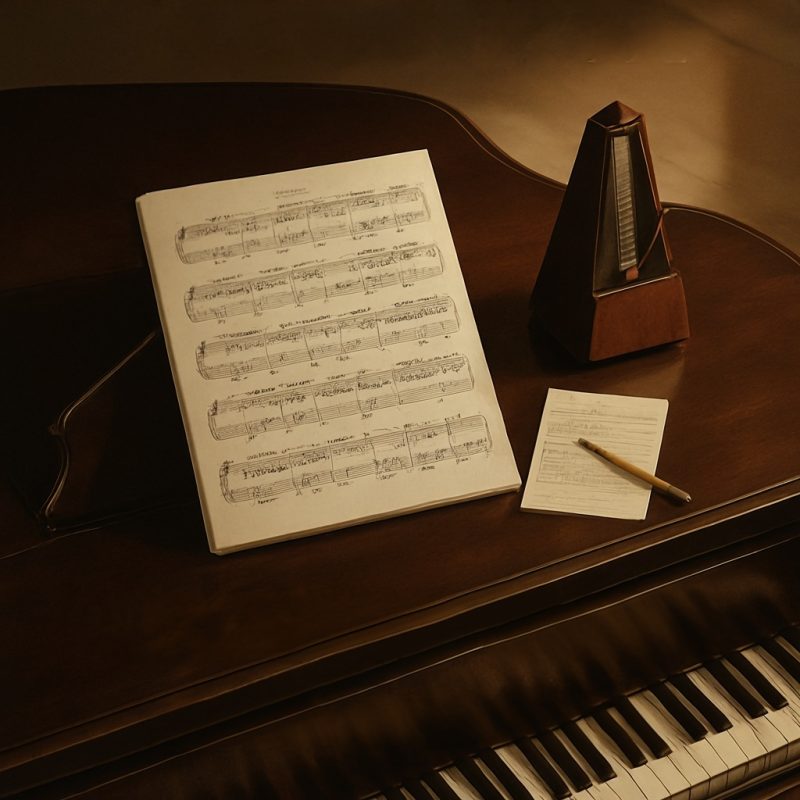
Sometimes I go into Beverly’s room for my time, the metronome beating like a heart, and we just talk. Mom must know I’m not playing, but she just waits outside on the couch. Because I’m with Beverly, who holds my hand to help me reach an octave.
My tears are dripping on the keys as I tell her about the boy who smells like wild weeds, and how it feels to be a Fantasia and a Pathetique all at once. Beverly understands. To her, my talents are playing songs in the key of flowers and asking about lady composers.
Her God understands. Maybe He lives in her garden. Maybe He’s a lady composer. I feel better when I tell her what I’m translating when I play, and she says to keep on being myself. Decades later, I still hear her saying it.
Beverly’s gone now, after my college and her cancer, but somehow she’s not. I can’t afford a piano, only a pen. But I still feel her soft hands helping me reach on octave, like shaping cookie dough. And I still play for her every day. I’m doing it now as the ink smears my hand, my fingers following the logic of the wildflowers, just for Her.

“[they] wrote stories with notes instead of words”
Wow.
Before word processors and television, came classical movements that somehow made the planets dance.
There’s something about a teacher—or any kind of mentor—who can bring the life out of us. Even if it doesn’t make sense to the people we love most (too often, our own parents), they know how to coax us out by making us feel safe. They don’t demand Beethoven or Bach. They wait patiently for you. And that’s what Beverly did.
Thanks for your lovely observation about mentors, Stefanie! So true, and I bet you had several yourself! Now it’s our turn to do that for others. I like what you said about classical music making the planets dance.
The melodies of nature… beautiful partnership Laura. Enjoyed memories of Beverly very much.
Mimi, Beverly would be happy to know she now made an impact on you too! Amazing how we can spread the love with stories!
I absolutely loved the poetry in this piece. My favorite line is, “Instead, I’m counting thistles that line the road like cathedral spires and speak of the beauty to come.” The balance between poetry and prose in this is wonderful.